Wildlife in S'Albufera de Mallorca
A paradise of fauna and flora to explore on the vibrant Balearic Island of Mallorca.
Palma de Mallorca has long been know for its paradisiacal beaches, but what many do not know is that this beautiful Balearic Island is home to a surprising diversity of fauna. S'Albufera de Mallorca Natural Park makes it possible for all nature lovers to discover its wonders.
Situated on the northeastern coast of the island, S'Albufera de Mallorca is a protected natural park characterised by its vast wetlands, which are known to attract many incredible species. Here, you can observe resident and migratory birds at close range from the hides strategically located throughout the park. Simply walking along its paths can also be a magical experience: if you remain attentive, you may come across Camargue horses, Mallorcan cattle and a huge variety of other wildlife.

Which wildlife can be seen in S'Albufera de Mallorca
For animal lovers, this is the most exciting part of visiting S'Albufera de Mallorca Natural Park. The park is home to more than 64 breeding bird species, while around 303 species have been recorded there.
I had an amazing time visiting this park. It is well maintained, and its several incredible hides make it possible to observe the wildlife without being seen. It is like watching a bird documentary live! Not only did I see a vast variety of birds, but I was able to observe them going about their lives: mating, hatching, fighting and hunting. It was a lovely experience!
When I entered the park, I followed the path along the Gran Canal and, right there, I could hear the loud calls of Weastern cattle egrets. Looking attentively at the trees across the canal, I could see them: tiny white dots scattered throughout the trees branches. Some would fly over the canal, where large fishes could be seen happily jumping out of the water.

Walking along the the path took me to the information center, and from there I began exploring the different itineraries. There are four itineraries: three short ones, each around one kilometre long, and one much longer route of approximately 11 kilometres. I completed all the short itineraries, as the long one would require either a bicycle or practically an entire day of walking—I usually make many stops to observe the fauna and flora.
El Cibollar
Of all the itineraries in S’Albufera de Mallorca, Es Cibollar was undoubtedly my favourite. Walking through an incredible tunnel of leaning trees made me feel as though I was in an enchanted forest. The two hides along this route also offered the best views of Mallorca’s wildlife.
Es Cibollar enchanted forest Bridge to the El Cibollar hide
Here I was able to observe Little Ringed Plovers, Pied Avocets, Black-winged Stilts, Great Flamingos, Common Shelduck, Common Tern.

Great Flamingo 
Little ringed plover 
Common shelduck 
Pied avocet 
Black-winged stilt 
Great Flamingo and Common Tern
Sa Roca
The green path leading south from the information center offered a beautiful scenery. On the way to the hides, I spotted some beautiful Camargue Horses and a Glossy Ibis.

From Sa Roca hide, I had the opportunity to observe a Little egret hunting. It was undoubtably a beautiful experience. Later, beside a small canal near the path, I saw a pair of Red-knobbed Coots - a critically endangered species in Mallorca.
Little egret Red-knobbed coot
Along the small canal, there were numerous Dragonflies and Damselflies of all sizes and colours. I managed to capture this photograph of a Scarlet Dragonfly.

Es Colombars
This was the most monotonous itinerary of them all, as the surroundings only begin to change towards the end of the route, where the Es Colombars hide is located.
The landscape here is not as beautiful as along the other paths, partly because of the view of the enormous power plant, which somewhat disrupts the natural atmosphere.
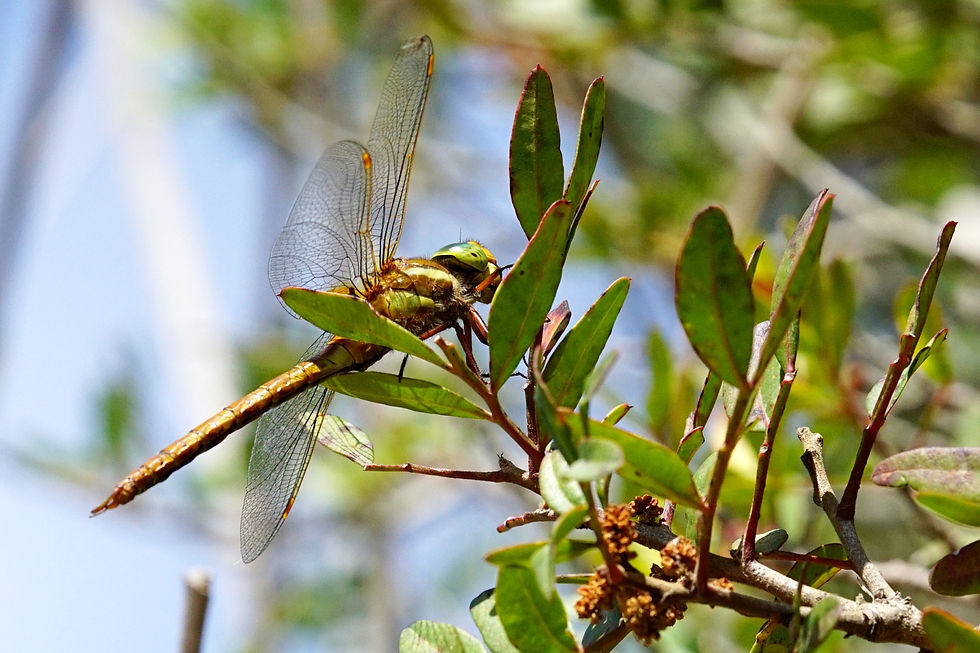
Nevertheless, the route still rewarded me with an unexpected encounter: a beautiful Green-eyed Hawker Dragonfly. Even the least interesting path can offer something special when you pay close attention.
S'Albufera de Mallorca Rules
The natural park is open to everyone and can be visited free of charge throughout the year. However, there are some rules that visitors must respect to ensure that the wildlife of S’Albufera de Mallorca remains undisturbed.
First of all, this is a sanctuary for wildlife, so visitors must not disturb either the fauna or the flora in any way. Excessive noise is unwelcome, including running, speaking too loudly or children playing too wildly. Dogs are not permitted because most of the park’s wildlife would perceive them as predators, causing unnecessary stress. Removing fauna or flora is forbidden, and visitors are asked to remain on the designated paths at all times.
Picnics are also forbidden, although you may have a snack in the designated areas. Last but not least, feeding the animals is strictly prohibited. Wildlife should not become dependent on humans, and the kinds of food people tend to offer animals can cause disease and malnutrition.
There are some more rules that you can read at the S'Albufera main entrance, but these were the ones that caught my attention the most.
When to visit the Natural Park
Although S'Albufera Natural Park is open throughout the year, it is not open all day, so I advise consulting the current opening hours before your visit. The park is usually open to visitors from 9 a.m. to 6 p.m. during the high season and from 9 a.m. to 5 p.m. during the low season.
I strongly recommend you to visit early in the morning if you wish to explore the park in peace and relative silence, as it can become a little too crowded from midday onwards.
Keep in mind that the season you visit may affect which species you encounter. I visited S'Albufera de Mallorca in April, when many migratory species pass through the wetlands, and the entire park seemed full of life.

Finally, bring binoculars if you have them. The hides provide excellent opportunities to observe wildlife, but some birds may still be too far away to appreciate properly with the naked eye.

S’Albufera showed me a completely different side of Mallorca—one far removed from crowded beaches and coastal resorts. Between its wetlands, shaded paths and constantly changing birdlife, it is a place that rewards patience and attention. The more slowly you explore it, the more it reveals.
Comments