Snorkelling in Kulkwitzer See
Updated: Aug 23
Immerse yourself in crystal-clear waters and discover the rich underwater world of Kulkwitzer See in Leipzig.

Only 12 km from Leipzig city centre, on its western edge, Kulkwitzer See presents itself as a peaceful retreat from busy city life. Surrounded by forest and greenery, this urban lake is a very accessible option for those looking for an easy-to-reach yet rewarding snorkelling experience.
With its remarkably clear water and good underwater visibility, it is easy to spot large fish and shoals even from several metres away. I had several exciting encounters during my session and can only recommend snorkelling in Kulkwitzer See.
Visibility and underwater conditions
Water Clarity

I visited Kulkwitzer See on a sunny summer Friday in the late morning, and there were already plenty of people at the bathing beach. Close to the shore, the water contained some suspended sediment due to the high level of activity, but as I swam farther away, the particles became much less prominent, making it very easy to spot large fish and schools of smaller fish.
Kulkwitzer See is well known among divers for its good underwater visibility. From the surface, I would estimate that I could see down to at least four metres, which is impressive for a lake with so much recreational activity.
With a maximum depth of around 32 metres and an average depth of approximately 20 metres, Kulkwitzer See is a remarkably deep lake. Good visibility therefore matters not only for swimmers and snorkellers in the shallows, but also for the diving community that regularly uses the lake.
Entering Conditions
There are plenty of swimming beaches around Kulkwitzer See, making it easy to start a snorkelling session. I visited the beach on the eastern side of the lake, which had dense reed beds at both ends and also along the small narrow peninsula in front of the beach — easy to reach by swimming if you feel confident in the water.
The beach itself is sandy, but at the waterline the bottom quickly changes to very fine gravel made up of small stones. Farther from the shore, at around two metres depth, the lake bed becomes softer, with patches of fine sand appearing between a low carpet of aquatic vegetation.
Wildlife I observed in Kulkwitzer See

Rutilus Roach
Rutilus Rutilus

Commonly found in shoals when young, roach are easy to recognise by their silvery-white appearance, orange-red fins and reddish eyes. Juveniles are often found in shallower waters, while larger adults may occur across a wider range of depths and habitats.
I spotted only two shoals of roach during my snorkelling session at Kulkwitzer See, probably because the larger fish I encountered stole most of my attention. Nevertheless, it is always a pleasure to see these medium-sized fish shining in a group, their silvery scales reflecting the sunlight as they swim.
European Perch
Perca fluviatilis

Easily identifiable by its colourful orange fins and distinctive irregular dark vertical stripes, the European perch - Perca fluviatilis - is very common in Kulkwitzer See in Leipzig. This predatory freshwater fish often moves in shoals while young, providing protection from predators and improving feeding efficiency. As they grow larger, perch become less strongly shoaling. Large adults may form smaller groups or spend more time alone, particularly when hunting larger prey.
I saw several schools of European perch moving around the large marker buoys covered in aquatic weeds. Here they could find safety among the weeds and a better chance of locating food. The small juvenile perch moved quickly and in synchrony, and depending on how the sunlight reached them, they looked like tiny particles of silver reflecting light through the cyan-blue water.
Northern Pike
Esox lucius

Northern pike is a fascinating freshwater fish. Its long, slender anatomy makes it an extremely fast and merciless predator. Unlike other predatory fish such as the European perch, it often waits very still and camouflaged within its habitat, and as soon as its prey approaches, it darts forward in the blink of an eye.
I was lucky enough to capture this juvenile Northern pike among the dense reed beds around the small peninsula. It remained motionless, waiting for prey to approach, but the little European perch eventually turned back and never became its snack — at least while I was watching!
Northern pike generally avoid swimmers and pose little danger, but they should be observed from a respectful distance without being approached or cornered.
Common Carp
Cyprinus carpio

Common carp, or European carp - Cyprinus carpio, are easily recognised by their robust build and the two pairs of short barbels around the mouth. Despite their large and imposing appearance, they have no teeth in the jaws and are generally peaceful fish. Carp are omnivorous and are commonly found near the bottom of lakes, where they search the sediment for molluscs, crustaceans, insect larvae, plant material and other food.
Their feeding behaviour can, however, have a noticeable influence on shallow lake habitats. By disturbing soft sediment and uprooting submerged vegetation while foraging, carp can contribute to the decline of aquatic plant beds. These plants are important for water clarity, habitat structure and the overall ecological balance of the lake.
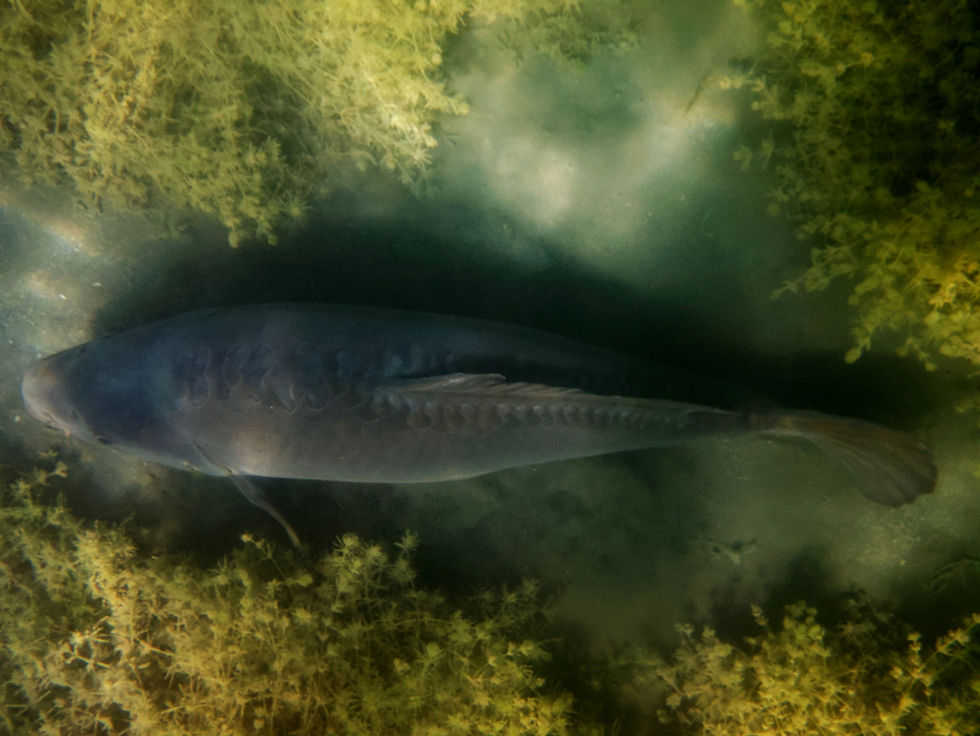
Soon after I entered the water and swam a few metres away from the shore, I spotted a couple of carp feeding on the lake bed at a depth of no more than about two metres. I was surprised to see them so close to the beach, as many people would swim past them without ever noticing their presence so close to their feet. During the session, I encountered several other large carp resting or feeding over open sandy patches between the weed beds. The individuals I observed appeared to be leather carp, a variety of common carp with very few scales, giving the body an unusually smooth appearance.
Freshwater Bivalve Shells & Small Aquatic Snail Shells
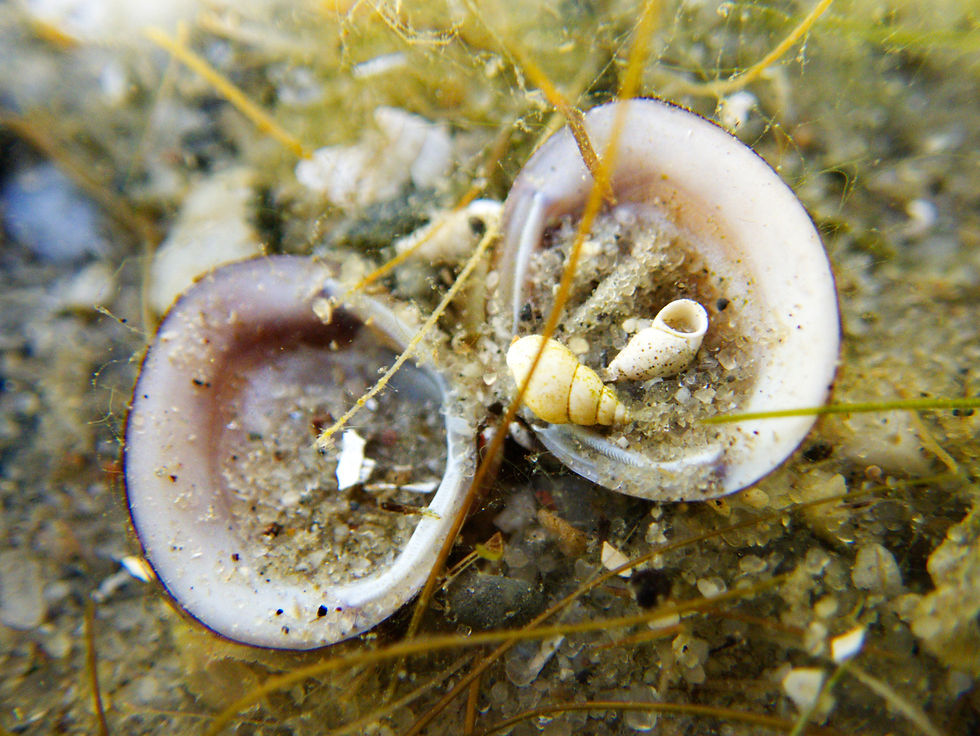
Freshwater snails and bivalves are another small but important part of Kulkwitzer See’s underwater life. They can often be found resting on the lake bed, among aquatic vegetation or attached to harder surfaces, where they feed on algae, organic matter and microscopic organisms. Their empty shells also remain scattered across the bottom, sometimes creating tiny shelters for other invertebrates.
During my snorkelling session I came across several small snail shells and larger bivalve shells lying among the sand, plant remains and gravel — easy to overlook at first, but a beautiful reminder of how much life exists even in the smallest details of the lake.
Watermilfoil
Myriophyllum sp.

Watermilfoil (Myriophyllum sp.) is an important submerged plant in freshwater lakes. Its finely divided leaves provide shelter and feeding areas for small fish, insect larvae and other aquatic invertebrates, while the dense growth also offers hiding places for juvenile fish. Like other aquatic plants, watermilfoil photosynthesises, producing oxygen and helping support the lake’s underwater ecosystem.

Near the peninsula, in the shallow water not far from the reed beds, I spotted something very shiny, almost like tiny jewels. As I approached, it seemed as if glitter had been scattered all over the weed beds. It was such a beautiful sight, and when I got very close, I realised that the leaves and stems were covered in tiny bubbles. It looked as if the watermilfoil was breathing.
This magical moment was in fact the result of photosynthesis: under the strong summer sun, the watermilfoil was releasing oxygen, which collected as tiny bubbles on the plant.
Bristly stonewort
Chara cf. hispida

Bristly stonewort - Chara cf. hispida - is a large charophyte alga that can form dense underwater meadows in clear, calcium-rich freshwater. Despite its plant-like appearance, it is actually a type of green alga, with stiff branching stems that create important structure on the lake bed. These dense growths provide shelter for small fish and invertebrates, help stabilise sediment and can contribute to clearer water by reducing the amount of material that is stirred up from the bottom.
In Kulkwitzer See, I found it forming extensive carpets across the shallower areas, creating an almost meadow-like underwater landscape.
Filamentous green algae
Chlorophyta

Filamentous green algae form long, hair-like strands that can gather into dense, soft mats over the lake bed, rocks and submerged vegetation. Unlike cyanobacteria, which can form harmful blooms and sometimes produce toxins, filamentous green algae are generally harmless to swimmers and are a natural part of freshwater ecosystems. In small amounts they provide habitat for microorganisms and tiny invertebrates. When they grow very densely, however, they can cover aquatic plants, reduce the light reaching them and trap sediment.
During my snorkelling session at Kulkwitzer See, I found particularly thick accumulations around the shallow reed beds near the peninsula, where the algae formed almost cloud-like masses between the stems, over rocks and sometimes across the weed beds.
Great Cormorant
Phalacrocorax carbo

Great Cormorants are large, beautifully dark birds that feed primarily on fish caught while diving. They are impressive underwater hunters, using their powerful webbed feet to propel themselves beneath the surface and pursuing fish at several metres depth.
They are commonly found around German lakes and are often seen resting together near the water. One of their most characteristic sights is a bird perched with its wings spread wide, allowing its plumage to dry after diving.
At Kulkwitzer See, I spotted only one individual. It was sitting on one of the large marker buoys, where it spent several minutes with its long dark wings stretched out to dry. Once its plumage had dried, it folded its wings and flew away.
Other species
I also spotted some other common bird species, including the Eurasian Coot and Mallard Duck. Around the reeds and shoreline, the lake was alive with dragonflies and damselflies in a variety of colours.
Other Wildlife at Kulkwitzer See
Fish reported in Kulkwitzer See

Besides the species I encountered while snorkelling, a much broader fish community has been reported from Kulkwitzer See. Angler records list 14 species, including European eel, European perch, common bream, Prussian carp, grass carp, Northern pike, crucian carp, common carp, roach, rudd, tench, silver carp, European catfish and zander. These reports give an interesting glimpse into what may inhabit the deeper or less accessible parts of the lake, although not every species is necessarily easy to encounter while snorkelling, and angler records should be understood as reported occurrences rather than a guarantee of what will be seen during a visit.
Other wildlife likely to occur
Besides fish, Kulkwitzer See is home to a variety of other wildlife, especially around its reed beds and vegetated shoreline. Mute Swans and Great Crested Grebes can also be seen around the lake, while dragonflies and damselflies are particularly abundant during the warmer months. The shallow areas also support a variety of aquatic invertebrates, including freshwater snails, bivalves and insect larvae, while amphibians may occasionally occur along the quieter reed margins.
Facilities and Practical Information

Kulkwitzer See is very well developed when it comes to tourism and beach facilities. It offers a campsite, several rental facilities, restaurants and snack bars, a sauna and water sports centres.
Several diving bases operate directly at the lake, offering courses for beginners and experienced divers, equipment rental and, at some centres, guided dives. Small boats and pedal boats can also be rented around the lake.
Getting to Kulkwitzer See from Leipzig is very straightforward. Trams and buses run throughout the day, making the lake easy to reach by public transport. A well-developed cycle path also makes it a convenient destination by bike. Arriving by car from the city is equally easy, with several parking areas within walking distance of the main beaches.
Be aware of which beach you visit if you plan to take photographs. During my visit, I went to the beach immediately next to an FKK beach — an area dedicated to nudism where clothing is not permitted. The FKK beach had signs prohibiting photography. If, like me, you enjoy photographing nature and landscapes, I would recommend keeping some distance from the FKK area to avoid misunderstandings or uncomfortable situations.
Kulkwitzer See: a crystal-clear snorkelling experience

Snorkelling in Kulkwitzer See is very different from snorkelling in the Atlantic or the Mediterranean Sea. Freshwater offers less spectacular species diversity, but for curious swimmers who enjoy discovering even the smallest details of a natural ecosystem, this lake can be incredibly rewarding.
With its crystal-clear water, beautiful natural surroundings and easy accessibility, Kulkwitzer See offers a practical and enjoyable freshwater snorkelling experience close to Leipzig.
Text by Ana Mano · Photography by Ana Mano · AI-assisted illustrations and art direction by Ana Mano


Muito bonito e interessante, continua